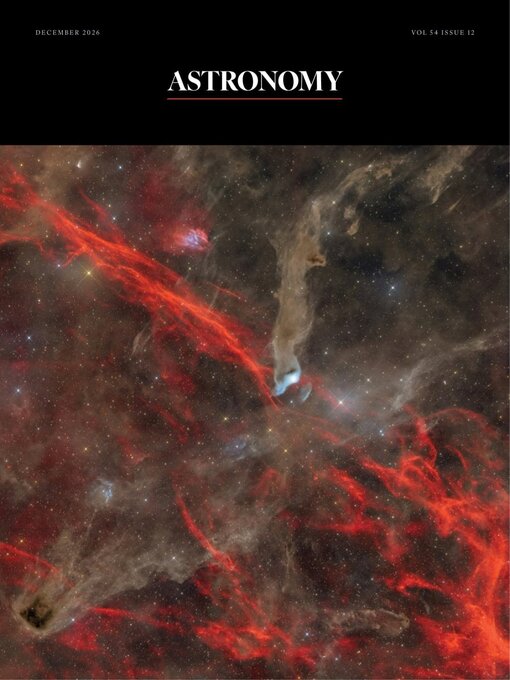
 Dec 01 2026
 Nov 01 2026
 Oct 01 2026
 Sep 01 2026
 Aug 01 2026
 Jul 01 2026
 Jun 01 2026
 May 01 2026
 Apr 01 2026
 Mar 01 2026
 Feb 01 2026
 Jan 01 2026
 Dec 01 2025
 Nov 01 2025
 Oct 01 2025
 Sep 01 2025
 Aug 01 2025
 Jul 01 2025
 Jun 01 2025
 May 01 2025
 Apr 01 2025
 Mar 01 2025
 Feb 01 2025
 Jan 01 2025
The world's best-selling astronomy magazine offers you the most exciting, visually stunning, and timely coverage of the heavens above. Each monthly issue includes expert science reporting, vivid color photography, complete sky coverage, spot-on observing tips, informative telescope reviews, and much more! All this in a user-friendly style that's perfect for astronomers at any level.
First Light
What’s Online
JWST Stares Down the Lion
Astro Letters
Astronomy Magazine’s 2026 Astrophotography Contest
Meet the Winners
December 2026: Satellites in Action
Meteor Watch
Rising Moon
Locating Asteroids
Comet Search
Star Dome: December 2026 • This map portrays the sky as seen near 35° north latitude. Located inside the border are the cardinal directions and their intermediate points. To find stars, hold the map overhead and orient it so one of the labels matches the direction you’re facing. The stars above the map’s horizon now match what’s in the sky.
Paths of the Planets: December 2026
Astronomers Catch ‘Galaxy-Killing’ Wind in the Act • The early universe is littered with galaxies that are no longer forming stars. Their own early growth may hold a clue to their deaths.
An Atmosphere on a Rocky, Habitable World • Helium escaping LHS 1140 b strengthens the case that the planet could support life.
Look-Back Time • Revisit some of our past contest winners — and see how astrophotography technology has changed.
Ejected Planetary Systems
Martian Meteors
More Than Meets the Eye • Seth Shostak’s mapping of hydrogen gas helped confirm decades-old evidence for dark matter.
Building a Travel Imaging Rig • The right equipment will ensure your journey to dark skies is successful.
New Products
When Doves Pass By
Astronomy’s 2027 Guide to the Night Sky • SPECIAL PULL-OUT SECTION
Winter Sky and Spring Sky
Summer Sky and Autumn Sky
Rise & Set
February 2027: Mars and Jupiter at their best • February 2027
Star Dome: February 2027 • This map portrays the sky as seen near 30° south latitude. Located inside the border are the cardinal directions and their intermediate points. To find stars, hold the map overhead and orient it so one of the labels matches the direction you’re facing. The stars above the map’s horizon now match what’s in the sky.
Astronomy